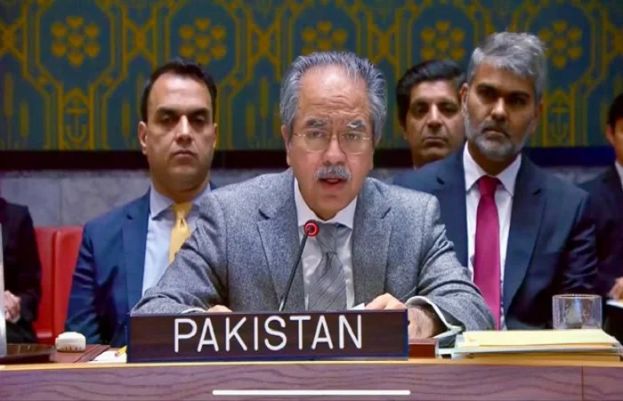
Pakistan on Monday cautioned the United Nations that the free movement of illegal arms within Afghanistan, many of them modern weapons now used by anti-Pakistan militant groups, poses a serious regional threat and is a major point of friction in its relationship with Kabul. During the UN Security Council Open Debate on Small Arms, Ambassador Asim Iftikhar Ahmad, Pakistan’s Permanent Representative to the UN, expressed deep concern over the presence of sophisticated arms and ammunition in Afghanistan, as highlighted in UN Secretary-General reports. “These advanced weapons pose a direct threat to neighbouring countries,” Ahmad said, stressing that militants operating from Afghan soil continue to endanger Pakistan’s security. The Pakistani and Afghan militaries clashed last month, resulting in dozens of casualties—the worst violence since the Taliban returned to power in 2021. Although both sides agreed to a ceasefire in Doha in October, talks in Istanbul failed due to disagreements over anti-Pakistan militant groups in Afghanistan. Ambassador Ahmad highlighted groups such as Daesh-K, TTP, Fitna Al Khawarij, BLA, and Majeed Brigade, which have reportedly used these weapons against Pakistani civilians and law enforcement, causing thousands of deaths. He also noted that some of these arms trace back to weapons abandoned by foreign forces or are sold via black markets in Afghanistan. “Smuggling networks and unregulated weapon movement across the border sustain terrorist and criminal groups, undermining regional peace and security,” Ahmad said. He called on the international community to strengthen efforts to prevent terrorist access to illicit arms in Afghanistan and urged the Afghan authorities to honor their international obligations. “The unchecked proliferation of small arms not only prolongs conflict but also hampers socio-economic progress and destabilizes the region,” the envoy warned. He stressed the human and social impact, noting, in terms of their impact on local communities, “Small Arms and Light Weapons are neither small nor light. “Illicit weapons impede development prospects, contribute to human rights abuses and imperil peace, security and stability.” Quoting the data on global terrorism, he added, “According to empirical data, small arms are the second most used weapons in global terrorist attacks, after explosives.” Focusing on Africa, Ambassador Ahmad highlighted the region’s vulnerability. “As highlighted by the Secretary-General’s report, Africa is one of the regions most severely affected by the illicit trade, misuse, and diversion of small arms and light weapons. “Illicit arms have fueled conflicts, amplified internal security threats, serving as tools for terrorism, organised crime, political violence, and the erosion of the rule of law – thus emerging as one of the foremost drivers of instability in the African continent.” He warned of the growing use of these weapons by non-state actors. “Small arms and light weapons have also emerged as instruments of choice for non-state actors to perpetrate violence. “These concerns are further exacerbated by the increasing sophistication of illicit arms and the accessibility of modernised weapons to illegal armed groups that frequently operate across national borders. “Illicit arms, thus, directly threaten national security, impede counter-terrorism operations, and civilian protection,” he said. The envoy also addressed modern challenges in arms proliferation. “The evolving nature of warfare and the advent of new technologies present serious challenges in combating the proliferation of increasingly lethal small arms, such as unmanned aerial vehicles, AI-based weapons, 3D-printed small arms, and high-tech night-vision equipment. “Criminal groups and terrorists are increasingly utilising technologies like cryptocurrency for anonymous transactions and employing the dark web to evade detection when acquiring such weapons,” he said. Pointing to solutions, Ambassador Ahmad added, “While new technologies have introduced new challenges in manufacturing and proliferation of illicit arms manufacturing, new avenues of effective control and international cooperation have also opened up, which need to be fully utilised. “Traditional arms control measures, designed for another era before the advent of these new technologies, must keep pace with new developments.” “We firmly believe that the issue of illicit small arms and light weapons should be addressed comprehensively and in a balanced manner. “The United Nations ‘Programme of Action on the Illicit Trade in Small Arms and Light Weapons in All its Aspects’ strikes a balance between the legitimate security requirements of states and the imperative to address the issue of illicit arms on both the supply and demand sides. “We remain committed to its implementation at the national level and call for its full execution at the global level to safeguard and promote international and regional peace and security,” he concluded with a call for balanced and comprehensive action.
Pakistan warns UN over Afghan weapons fueling cross-border terrorism