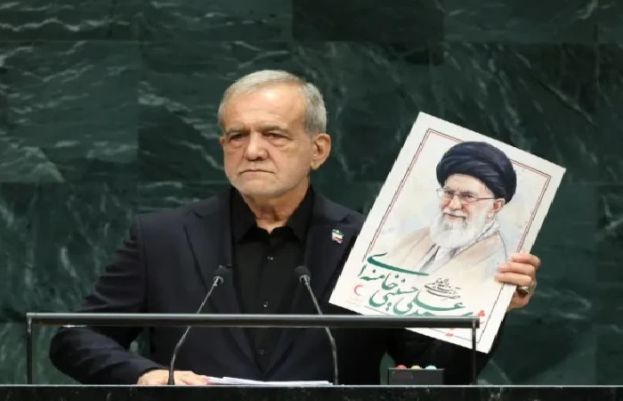
delivered a critique of Western hypocrisy at the UN General Assembly, exposing the contradiction of an Israeli regime armed with nuclear weapons and granted total impunity, while Iran faces relentless inspections and sanctions. Addressing the assembly, the Iranian official emphasized that trust cannot be built merely through rhetoric, but requires a fundamental abandonment of double standards. “The atomic bomb and other weapons of mass destruction in this region are in the hands of the Israeli regime; yet inspections are demanded of Iran!” Pezeshkian stated, highlighting the absurdity of the current international order. “Israel massacred 70,000 people in Gaza, yet Iran was bombed at the negotiating table!” Israel possesses nuclear weapons, refuses to join the Nuclear Non-Proliferation Treaty (NPT), and has never permitted a single international inspector into the occupied territories in its entire history, Pezeshkian said. “Yet, it is rewarded with billions of dollars in free weapons and enjoys absolute immunity to bomb any capital it chooses.” Summarizing the tragic paradox of the current geopolitical landscape, Pezeshkian reiterated: “I repeat: the nuclear bomb is in Israel, but the inspectors are in Iran! Israel kills, but Iran is sanctioned!” ‘We are victims of terrorism’ Pezeshkian held up photographs documenting war crimes against Iran by the United States and Israel. “We are not terrorists; we are the victims of terrorism,” Pezeshkian declared, directly confronting the accusations leveled by the “delusional” US president against the Iranian nation. Pezeshkian reminded the assembly of the unprecedented crimes committed against Iran. “I come from an Iran where our Leader was assassinated without any legal justification, without any proof,” he stated, referencing the assassination of Ayatollah Seyyed Ali Khamenei on the first day of the 40-day US-Israeli war of aggression. Displaying images of the schoolchildren massacred in the US bombing of the Shajareh Tayyebeh Primary School in Minab, Pezeshkian said, “I come from an Iran where they bombed a school. You can see these children. They bombed these children and killed them, with weapons they had from America and Israel. These children had committed no sin. They had committed no crime.” He also detailed the attack on the city of Lamerd, where US forces used high-tech missiles for the first time. “Lamerd is one of Iran’s small cities. There is a sports hall there where children were exercising. America bombed it with cluster bombs that split into thousands of pieces. They martyred our scientists, our people, our women, and innocent children who had committed no sin.” ‘They struck, but we did not bow’ Pezeshkian recounted the full-scale assault launched by the US and Israeli regimes using the latest military technology. “They struck, but we did not bow our heads before them. We struck back, but we did not strike civilians,” he said, drawing a moral distinction between Iran’s defensive response and the indiscriminate bombardment of civilian infrastructure. “They attacked our schools, our hospitals, our universities, our bridges, and our infrastructure from the territories they came from and were equipped in. All of this is in violation of international law.” The president also recalled the assassination of Hamas political leader Ismail Haniyeh in Tehran on his very first day in office, noting that the Israeli regime bombs and assassinates any government, state, or region it chooses with total impunity. Addressing the ongoing genocide in Gaza, Pezeshkian condemned the staggering hypocrisy of Western powers. “In Gaza, they massacred over 80,000 innocent human beings, and hundreds of thousands more are displaced. They commit genocide with the tools at their disposal. Then they say others are terrorists and that they are the source of instability.” “Are we the source of instability? We who want to live independently and refuse to bow our heads—are we the source of instability?” “If those who assassinate, kill, and commit crimes are the agents of security and peace, while they observe none of the rules of international law, then this is the reality we face.” ‘We do not ask permission to defend our country’ Pezeshkian firmly dismissed the narrative that Iran seeks regional domination. He said Iran has not attacked any country in 200 years and has always acted purely in self-defense. “We want power to defend ourselves, not to aggress. We want energy for development, not for building bombs, destruction, or threatening society. We want to participate in security.” Highlighting the extraordinary resilience of the Iranian people during the recent war, Pezeshkian said citizens have taken to the streets every single night to defend their homeland against US-Israeli aggression and prevent foreign-backed infiltrators from creating internal chaos. “For seven months, the people of Iran were in the streets day and night. The people are our power, and we stand with the power of the people.” On Iran’s defensive capabilities, Pezeshkian issued a clear message. “Our defense systems are built so that no one imagines that bombing Iranian cities will go unanswered. Iran’s power is for defense. But we say clearly: we do not ask permission from anyone to defend our country.” He outlined Iran’s strategic doctrine. “Iran must be powerful enough that its survival and progress are not threatened, responsible enough not to use its power for domination, and far-sighted enough not to seek its own security in the insecurity of its neighbors.” ‘Neither nuclear weapons nor deprivation’ Turning to Iran’s nuclear program, Pezeshkian dismissed the notion that nuclear knowledge should be the exclusive monopoly of a few nations. “For years, they have spoken about Iran’s peaceful nuclear program in the language of centrifuges, enrichment, sanctions, and bombs. But for our people, nuclear technology is part of the right to development.” “Nuclear energy means treatment for our patients, food security for agriculture, technology for industry, and sustainable electricity for the future.” “Iran does not accept that nuclear knowledge should be the exclusive privilege of a few countries. Iran does not consider nuclear weapons a factor of security, but it will not relinquish its right to science, industry, and peaceful energy.” “We say explicitly: neither nuclear weapons, nor deprivation from nuclear knowledge.” Pezeshkian said Iran’s nuclear issue cannot be resolved on the battlefield. “The solution is an agreement that provides the world with credible assurance of the peaceful nature of Iran’s program, and provides the Iranian people with assurance that their rights will be preserved.” ‘Hormuz cannot be used to threaten Iran’ Addressing the issue of the Strait of Hormuz, Pezeshkian exposed the fundamental contradiction of Western demands. “In the waterway of the Strait of Hormuz, we cannot be the historical guardian of a waterway that everyone benefits from, yet be deprived of the freedom of navigation even in our own waters.” “They close the road to us, and then they transport weapons, explosives, missiles, and energy for the destruction of countries through the same waterway. This is not possible. They cannot do this, and we will not allow such a thing to happen in our country.” “The permanent deployment of hostile fleets and the expansion of war do not bring security. The security of shipping cannot be ensured by undermining the security of coastal states.” ‘No peace without justice in Palestine’ Pezeshkian devoted a significant portion of his address to the Palestinian cause, declaring that lasting peace in West Asia is impossible without justice for Palestine. “We cannot speak of peace while ignoring Palestine. Lasting peace in West Asia will not last without justice for Palestine,” he stated. “As long as occupation, aggression, and injustice exist in the world, resistance will continue. If one form of it is harmed, it will emerge again in another form, perhaps even stronger.” He praised the unbreakable spirit of Gaza’s people. “Despite widespread killing and destruction, Gaza revealed the faith of the people—that resistance cannot be forced into surrender by bombs and siege.” “This is the nature of humanity. If you drive a human being from their land, they resist. If you bomb a person’s home, they resist,” Pezeshkian said. “What should they do if they do not resist? Accept bullying? Accept being driven from their homes and sit silently in the face of this aggression? And if they want to defend themselves, call them terrorists? This is the new discourse that has taken shape in the world we live in today.” The president said the problems of West Asia can and must be solved regionally, without interference from distant powers. “It is clear that the issues of our region, before becoming a pretext for the war of distant powers, can be solved in the region and by the region.” “Strategic independence means that relations with no foreign power become the possibility of war against a neighbor,” he added, rejecting any framework that allows external powers to use regional relationships as platforms for aggression. ‘Iran cannot be forced to surrender’ Pezeshkian addressed directly those who were responsible for the decision-making, planning, and execution of the attack on Iran. “Our nation has experienced their military power and the consequences of their destructive decisions up close. They have tested Iran’s resilience, and now they know well that Iran cannot be forced to surrender through war.” “Iran has never initiated any war and has always demonstrated its commitment to the negotiating table.” “War was imposed on us, but we proved that we do not fear war to defend ourselves; we do not flee from negotiation for peace, and we stand to the last breath for the defense of dear Iran.” Sanctions target the innocent Pezeshkian condemned the weaponization of economic sanctions, describing them as tools that intentionally target the poor and innocent, sacrificing ordinary people for the sinister agendas of hegemonic powers. “If we seek justice, friend and rival must be measured by the same standard, and human rights must not become a tool for geopolitical competition,” the president asserted. “Iran does not seek special privileges; it demands equal rights and is prepared to accept its responsibilities.” In a warning about the future of global security, Pezeshkian argued that a world that only understands the language of power will never achieve sustainable peace. “If trust among nations is destroyed, even the most powerful armies will be unable to create sustainable security,” he cautioned. “If international law is only enforced when it aligns with the interests of the powerful, more countries will conclude that they must rely solely on their own power to ensure their security. This will mark the beginning of a far more dangerous world for all of us.” The official urged the international community to prevent the 21st century from devolving into an era of coercion and tyranny, rejecting a world where military might replaces legitimacy, sanctions replace diplomacy, assassination replaces politics, and war replaces dialogue. Collective security and new international order Despite the harsh realities of the ongoing US-Israeli aggression, Pezeshkian reaffirmed Tehran’s commitment to maintaining its defensive capabilities while advocating for global peace. “Iran preserves its power. We call the world not to another war, but to peace and justice—not out of weakness, but out of confidence in our own strength and the understanding that no one in this region will have security alone,” he stated. “Either we will build security together, or we will endure insecurity together.” Pezeshkian outlined Iran’s vision for a future where security, justice, and human dignity are inalienable and shared rights for all nations. “An order worthy of being called ‘international’ must be based on the equality of nations, justice, fairness, and the shared will of humanity,” he concluded. “Because peace that is not for everyone is not peace, and justice that excludes everyone is not justice.”
‘Nuclear bomb in Israel, inspectors in Iran’: Pezeshkian slams glaring double standards at UNGA