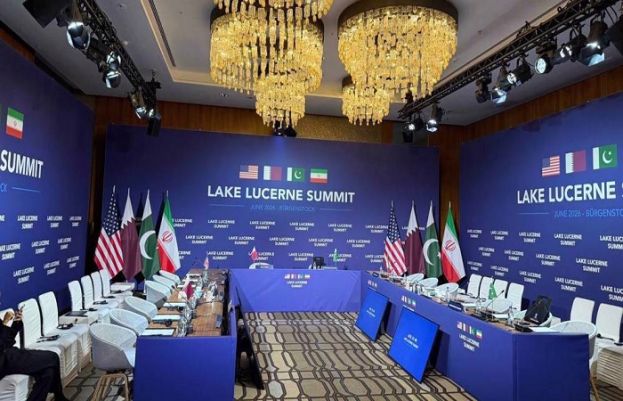
Four-way talks between Iran, the United States, and mediators Pakistan and Qatar have begun at the Burgenstock resort, launching a 60-day negotiation window under the 14-point Islamabad Memorandum of Understanding signed earlier this week. The Iranian delegation, led by Parliament Speaker Mohammad Baqer Qalibaf and including Foreign Minister Abbas Araghchi, will be pressing for full implementation of the memorandum. Iranian officials have reiterated that progress hinges on the US fulfilling its commitments under the preliminary deal, particularly its obligation to secure an end to Israeli attacks on Lebanon. The US delegation is headed by Vice President JD Vance, who arrived in Switzerland earlier Sunday, and includes Jared Kushner and Steve Witkoff. Pakistani Prime Minister Shehbaz Sharif, accompanied by Army Chief Field Marshal Asim Munir, is leading the mediation effort alongside Qatar’s Prime Minister Sheikh Mohammed bin Abdulrahman Al Thani. Upon arriving at the venue earlier Sunday, Qalibaf held separate meetings with Qatari and Pakistani mediators before leading his delegation into the four-party talks later in the day with US representatives present. Foreign Minister Araghchi also met separately with his Swiss counterpart on Sunday morning. Iranian negotiating team spokesman Esmaeil Baghaei said the main theme of the talks was demanding that the US implement its obligations under the Islamabad Memorandum of Understanding. Iran’s official IRNA news agency reported that the delegation would also press mediators to guarantee full implementation of the MoU by the United States, particularly a complete halt to aggression against Iran and its regional allies, with a specific emphasis on forcing Israel to end its attacks on Lebanon. Discussions are also expected to cover the lifting of US sanctions on Iran or measures to mitigate their impact, as well as a reduction in Iranian restrictions on maritime traffic in the Strait of Hormuz, a key Persian Gulf waterway that carries roughly one-fifth of global oil demand. The talks came a day after the Islamic Revolution Guards Corps (IRGC) declared the Strait of Hormuz closed to all vessels in response to US violations of its commitments under the Islamabad memorandum. The outcome of Sunday’s talks will determine the agenda for the second round of negotiations, with both sides trying to reach a comprehensive agreement to resolve outstanding disputes, including on Iran’s nuclear program. Baghaei, who is in Burgesnstuck to brief the media about the talks, said that Clause 13 of the MoU stipulates that launching negotiations to reach a final deal depends on the implementation of five clauses of the MoU, including its first clauses which clearly demand the cessation of war on all fronts, especially in Lebanon. “This clause has not been fully implemented so far, and the Zionist (Israeli) regime continues to violate its commitments in Lebanon, an issue that will be one of the main focal points of today’s talks,” he said. Baghaei also said that some other clauses of the agreement require taking preliminary and executive measures, including on the US side to release Iran’s blocked assets and to issue permits necessary for the exports of Iranian oil. He said that for the first time in the history of Iran-US indirect talks, representatives from the two countries would meet in one room in the presence of Qatari and Pakistani mediators. The Iran-US MoU was signed by the presidents of the two countries early on Wednesday, nearly two and a half months after Pakistan announced a ceasefire to stop the 39-day US-Israeli aggression on Iran. The MoU is aimed at putting a permanent end to that aggression and demands that Iran and the US carry out negotiations over a period of 60 days to reach a final peace deal.
Iran and US hold talks in Switzerland with Pakistan and Qatar as mediators