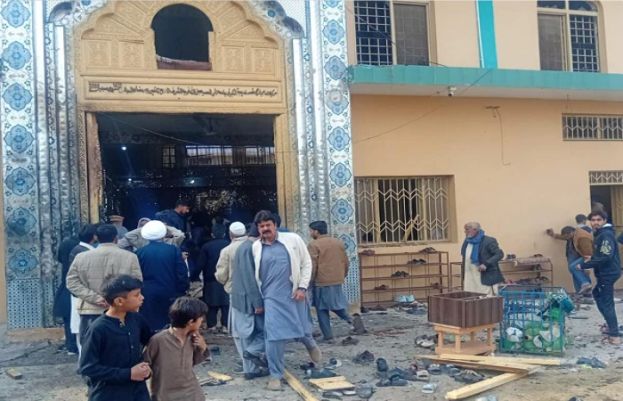
At least 12 worshippers were martyred and several others injured in a suicide bombing at an imambargah on the outskirts of Islamabad on Friday, police sources said. According to police sources, a suicide bomber targeted the mosque in the federal capital’s Tarlai area around Friday prayers. Police said the attacker was a foreign national and had links with Fitna al-Khawarij — a term used for Tehreek-e-Taliban Pakistan (TTP). The bomber detonated himself at the mosque gate after he was stopped by security personnel, the sources added. Police and security agencies have launched an operation at the scene and cordoned off the area, the sources added. The injured were being shifted to the Pakistan Institute of Medical Sciences (PIMS) for treatment. The blast comes days after Balochistan witnessed deadly attacks, carried out by the Balochistan Liberation Army (BLA), which claimed the lives of 36 innocent civilians, including women and children, along with 22 security and law enforcement personnel. Terrorists struck civilians in Quetta, Mastung, Nushki, Dalbandin, Kharan, Panjgur, Tump, Gwadar, and Pasni on January 31. A day earlier, the Inter-Services Public Relations (ISPR) said, security forces concluded Operation Raddul Fitna 1, eliminating at least 216 terrorists in various coordinated engagements and clearance operations. The attacks, since then, have drawn condemnations from countries including the United States, the United Kingdom, Saudi Arabia, Qatar, Turkiye, Iran, the UAE, France, Canada, the European Union, the OIC, the UNSC and others. Expanding on the counterterror operations, the military’s media wing said that operations were initiated in Panjgur and the outskirts of Harnai district on January 29, 2026, after credible and verified intelligence confirmed the presence of terrorist elements posing an imminent threat to the local public. “During this phase, security forces undertook operations against identified terrorist hideouts, resulting in the elimination of 41 terrorists affiliated with Indian proxy networks.” “Subsequently, aggressive and steadfast responses by security forces effectively thwarted the desperate attacks of Fitna al-Hindustan to destabilise the peace of Balochistan,” remarked the ISPR, adding that as a sequel to these, a broader series of intelligence-based operations were launched in multiple areas to dismantle terrorist sleeper cells through sustained combing and sanitisation operations.
Suicide blast at Rawalpindi imambargah martyrs 12