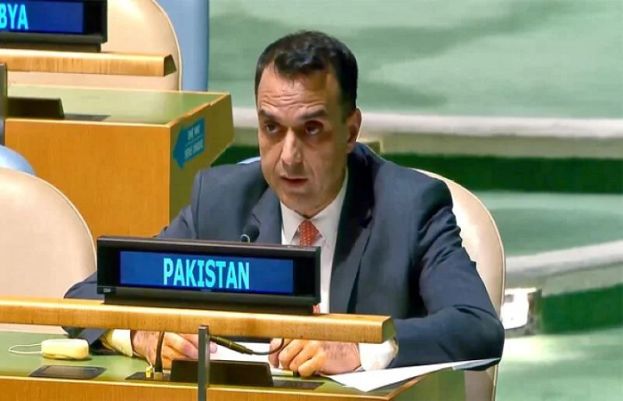
Islamabad has warned that New Delhi’s unilateral decision to hold the Indus Waters Treaty (IWT) in abeyance has created an unprecedented crisis for Pakistan’s water security and regional stability. The concerns were raised by the Acting Permanent Representative of Pakistan to the United Nations, Ambassador Usman Jadoon while speaking at the Global Water Bankruptcy Policy Roundtable hosted by the Permanent Mission of Canada and the United Nations University (UNU). Ambassador Jadoon said that India’s decision, taken in April last year, was followed by material breaches of the treaty, including unannounced disruptions of downstream water flows and the withholding of hydrological information. He described India’s decision as a deliberate weaponisation of water and said that Pakistan’s position on the Indus Waters Treaty is unequivocal. “Pakistan’s position is unequivocal; the Treaty remains legally intact and permits no unilateral suspension or modification,” he added. Ambassador Jadoon said that for more than six decades, the Indus Waters Treaty of 1960 has served as a time-tested framework for equitable and predictable management of the Indus River basin. Highlighting the importance of the basin, he said it sustains one of the world’s largest contiguous irrigation systems, provides over 80% of Pakistan’s agricultural water needs, and supports the lives and livelihoods of more than 240 million people. The ambassador said water insecurity has emerged as a systemic risk across regions, affecting food production, energy systems, public health, livelihoods, and human security. Referring to Pakistan’s situation, he said the country is a semi-arid, climate-vulnerable, lower-riparian state facing floods, droughts, accelerated glacier melt, groundwater depletion, and rapid population growth, all of which are placing immense pressure on already stressed water systems. He said Pakistan is taking steps to strengthen water resilience through integrated planning, flood protection, irrigation rehabilitation, groundwater replenishment, and ecosystem restoration. He cited initiatives such as Living Indus and Recharge Pakistan in this regard. Ambassador Jadoon said systemic water risks cannot be managed by any nation alone, particularly in shared river basins. He said that predictability, transparency, and cooperation in transboundary water governance are matters of survival for downstream populations. The ambassador added that water insecurity should be recognised as a systemic global risk in the lead-up to the UN Water Conference 2026, calling for cooperation and respect for international water law to be placed at the center of shared water governance to ensure protection for vulnerable downstream communities.
At UN, Pakistan warns India IWT suspension threatens water and food security