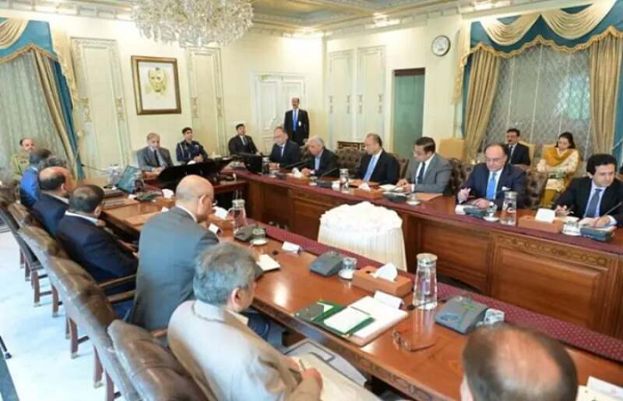
The federal government on Monday announced a series of bold policy measures aimed at reviving Pakistan’s economy, providing relief to citizens, and strengthening the country’s export sector. Key initiatives include the withdrawal of the 0.25% Export Development Surcharge (EDS), a reduction in prescribed gas prices, approval of over Rs507 billion in development projects, and enhanced oversight of state-owned enterprises (SOEs). The decision to scrap EDS was taken during a high-level meeting at the Prime Minister’s House, attended by senior federal ministers and private-sector representatives. The move is expected to make Pakistani exports more competitive internationally and provide immediate relief to exporters. A dedicated Working Group on EDS, chaired by Musadaq Zulqarnain and including prominent private-sector leaders and government officials, was formed earlier to review the Export Development Fund (EDF). An interim steering committee will now oversee the utilization of Rs52 billion in EDF funds, prioritizing research and development, skill-building, and competitiveness-enhancing initiatives. “Exporters have long argued that the surcharge was more of a burden than a facilitator. Its removal signals the government’s renewed commitment to supporting exports,” said Khurram Mukhtar, a member of the working group. Development Projects Approved Across Sectors The Executive Committee of the National Economic Council (ECNEC), under Deputy Prime Minister Ishaq Dar, approved development projects worth over Rs507 billion, covering education, health, water supply, infrastructure, and emergency programs. In the education sector, ECNEC approved the reconstruction of 481 flood-affected schools in Sindh on a 50:50 cost-sharing basis with the provincial government. In health, the KP Human Capital Investment Project (Health Component), funded by a World Bank loan, received clearance. Major infrastructure projects, including the Mangla Dam raising, road expansions in Balochistan, and the Karachi-Lahore Motorway, were also approved. The Emergency Polio Eradication Programme (2026–2029) was extended with a revised financial envelope of $639.54 million, reflecting Pakistan’s commitment to global polio certification and integration of polio assets into the national Expanded Programme on Immunisation (EPI). Strengthening Governance of State-Owned Enterprises The Cabinet Committee on SOEs approved the appointment of independent directors to the boards of ZTBL, SNGPL, Port Qasim Authority, Sindh Engineering, SMEDA, and the State Engineering Corporation. The move aims to improve governance, transparency, and operational efficiency. Looking Ahead Analysts say the combined package of reforms, development spending, and institutional restructuring is a signal of the government’s renewed focus on economic revival, public welfare, and export competitiveness. Observers also note that follow-up measures on taxation of export-oriented industries are expected to further improve Pakistan’s global trade position. The CCoSOEs met in Islamabad under the chairmanship of the Federal Minister for Finance and Revenue, Senator Muhammad Aurangzeb on Monday. The Committee considered summaries submitted by the Finance Division, Maritime Affairs Division, Petroleum Division, and the Industries and Production Division, and approved the agenda items presented. These included the appointment of an independent director to the Board of Zarai Taraqiati Bank Limited (ZTBL), put forward by the Finance Division; the appointment of independent directors to the Board of Port Qasim Authority, Karachi, as proposed by the Maritime Affairs Division; and the nomination to fill the casual vacancy on the Board of Sui Northern Gas Pipelines Limited (SNGPL), submitted by the Petroleum Division. The Committee also approved three summaries of the Industries and Production Division, namely the constitution of the Board of Directors for Sindh Engineering (Pvt) Limited (SEL), the appointment of a private sector member from Punjab to the Board of the Small and Medium Enterprises Development Authority (SMEDA), and the constitution of the Board of Directors of the State Engineering Corporation (SEC). Concluding the meeting, the Chair appreciated the diligence exercised in selecting suitable candidates from the private sector to serve as independent directors, underscoring the importance of continuing this rigorous approach to ensure that individuals with the requisite experience, expertise, knowledge, and professional acumen are appointed to the governing boards of these and other state-owned enterprises. The Committee also asked the Finance Division and the Privatisation Division to undertake a comprehensive examination, evaluation, and stock-taking of outstanding litigation across SOEs earmarked for privatisation, and, in coordination with the relevant Ministries and Law Division, to work on identifying mechanisms to smooth these issues in order to ensure their readiness for a seamless privatisation process.
Govt Withdraws Export Development Surcharge to Support Exporters