By Syed Talat Abbas Shah — Human Rights Journalist/ Defender & Analyst
The courtroom confession of Mohammad Sharifullah, a Daesh-K operative linked to the catastrophic bombing at Kabul airport in August 2021, is more than just the unmasking of yet another foot soldier in the global terror network. It is a mirror held up to a region that continues to fracture under the weight of unresolved political failures, cross-border militant mobility, and the absence of a coherent security architecture.
His admission that he scouted the route enabling the Abbey Gate suicide attack brings a rare moment of factual clarity in a conflict defined by murky alliances and shifting narratives. But clarity does not equal closure. Not for the Afghan families who lost everything in the blast. Not for the 13 U.S. Marines killed doing what should have been a humanitarian duty. And certainly not for the region, where every confession seems to reveal yet another layer of international neglect and local complicity.
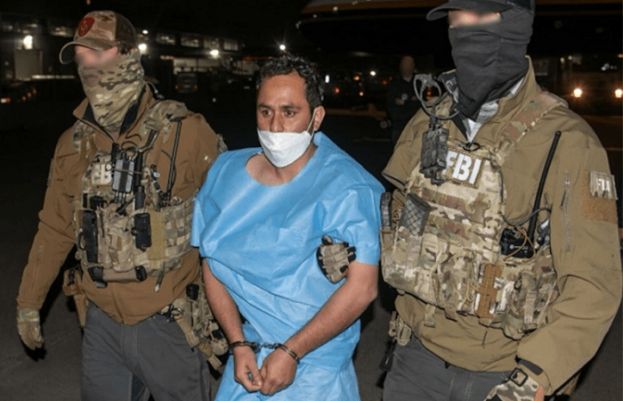
Sharifullah’s appearance in a Virginia courtroom, wearing light blue prison garb and a black mask, brings a symbolic contrast: a militant who thrived in stateless chaos now answering to a system of due process. Yet this same system omits the conversation the region desperately needs — how did these groups grow, move, network, and operate with such ease between Kabul, Khyber, and beyond?
The Justice Department affidavit paints a picture that is both predictable and tragic. Daesh-K operatives gave Sharifullah a burner cellphone, tasked him with confirming the route, and sprung into action once he signaled “all clear.” This wasn’t sophisticated terrorism this was low-tech brutality thriving in a power vacuum.
And the vacuum has never really closed.
Predictably, his arrest has reignited the Kabul–Islamabad blame game. Pakistan cites Afghan soil as the launchpad for attacks by TTP and Daesh affiliates. The Taliban regime counters by claiming the arrest is “proof” of Daesh-K presence inside Pakistan. Both statements are politically convenient and dangerously incomplete.
Reality is far more complex:
Militant groups today are transnational organisms, feeding on weak borders, intelligence gaps, and political mistrust. They operate in the space where state capacity collapses and geopolitical interests collide. To pin them entirely on one side of the Durand Line is to misunderstand the nature of the threat.
High-profile acknowledgments from former President Donald Trump calling Sharifullah “the top terrorist responsible,” to Prime Minister Shehbaz Sharif thanking the U.S. shift the conversation toward diplomatic point-scoring rather than actual root causes.
Why is no one asking the real questions?
-
Why did Daesh-K manage to embed itself so deeply in both countries while both governments claimed counter-terror successes?
-
Why have border communities paid the heaviest price while national capitals exchange rhetorical fire?
-
Why does the region still lack a rights-based, accountable counter-terror framework rooted in regional cooperation rather than political theater?
Until those answers emerge, every arrest even a high-value one is an isolated victory at best.
Sharifullah’s alleged involvement in the 2024 Moscow Crocus City Hall attack shows exactly how these networks operate today: not as isolated cells but as hyper-adaptive ecosystems with global aspirations. He reportedly instructed attackers via video, thousands of kilometers away. This is the new face of extremism portable, transferable, borderless.
States, meanwhile, are still stuck in outdated debate:
“Your militants” vs. “our militants,”
“My victim narrative” vs. “your victim narrative.”
Extremism does not care for these lines.
Human rights defenders have been warning for years that treating militancy through the lens of political rivalry rather than structural reform only helps the militants evolve further.
The victims Afghan civilians, American soldiers, Pakistani border residents, Russian concertgoers are all casualties of a broken regional architecture. Their rights, safety, and dignity remain secondary to the geopolitical chessboard.
A justice system may convict Sharifullah.
But who will convict the systems that made him possible?
Until Afghanistan and Pakistan adopt a truly cooperative, rights-driven security strategy backed by transparent governance, community protection mechanisms, and deradicalization programs the cycle will continue.
Sharifullah’s confession is not closure.
It is a warning.
And we ignore it at our own peril.
